
By: Jill Nelson
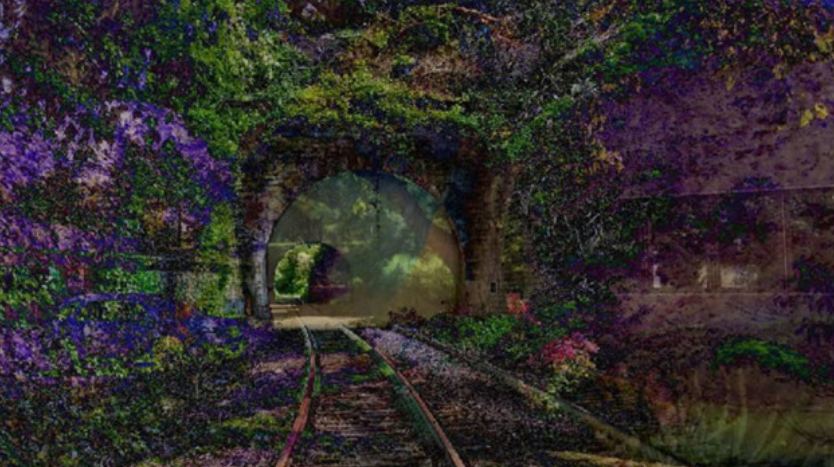
The picture at issue, “A Recent Entrance to Paradise”. [1]
The Supreme Court’s recent refusal to hear Thaler v. Perlmutter makes clear that AI-generated works cannot receive copyright protection because authorship requires a human mind. [2]Although AI can be sophisticated, it does not meet the necessary criteria.
Thaler’s legal journey began in 2018, when he first sought to copyright A Recent Entrance to Paradise. [3]Thaler faced rejection from the Copyright Office, a loss in federal court, and another loss at the U.S. Court of Appeals. [4] Now, on March 2nd, 2026, the Supreme Court declined Stephen Thaler’s petition seeking copyright for an image generated entirely by his AI system, “Creativity Machine”, allowing the D.C. Circuit’s ruling that AI generated works without human authorship are not copyrightable to stand. [5] Courthouse News similarly emphasizes that D.C. Circuit’s opinion frames human authorship as a “necessary condition” under the Copyright Act of 1976. [6] Judge Patricia Millett explained that copyright is a form of property that can be inherited or transferred, and that the duration of copyright is parallel to a human lifespan. [7] These are actions that require a human to be the owner.
The Supreme Court’s silence effectively affirms the Copyright Office’s position that human authorship is a fundamental requirement. [8] This outcome marks another defeat for Thaler, who has repeatedly attempted to secure property rights for outputs of his AI systems, which includes Thaler’s earlier efforts to patent inventions with AI listed as inventors. [9] National Today noted that the denial “solidifies the current legal stance that AI-generated art cannot be copyrighted, which could have significant implications for the growing creative industry around AI powered art and content generation”. [10]
There can be some perspective on this issue, placing it in a broader policy context. [11] The Copyright Office has recently issued guidance that clarifies that AI-generated artwork based solely on prompts is not protectable by copyright. [12] Even when AI can assist in the inventive process, human authorship is the “bedrock requirement of copyright”. [13] The UK has also reached the same conclusion that is similar to the case brought by Thaler. [14] But, the UK recognizes “computer generated” works as copyrightable and assigns the authorship to the “person by whom the arrangements necessary for the creation of the work are undertaken”. [15]
If AI-generated works could be copyrighted or even patented, the volume of filings would flood the system, as we see an attempt here. AI systems can generate hundreds and thousands of images, texts, or other variations of works in a span of a few seconds. Granting protections for AI generated works would fill the legal system, dilute the value of human creativity, and eventually lead to monopolies over AI algorithmic recombination of the already-existing works. [16]
The question then becomes, what is left for humanity? If AI becomes the legal creator, humans run the risk of becoming operators, or even worse, irrelevant. AI systems do not create the same way humans do. [17] AI systems generate outputs based on the different information fed into them. [18]AI then remixes, recombines, and reassembles that information, not originating it.[19] To grant authorship or inventorship would be granting credit for the human creativity that it depends on. We feed AI systems with our own prompts, statements, and ideas, and keeping authorship with a human requirement is a safeguard for the future of creativity itself.
The Supreme Court’s refusal to hear Thaler’s case is more of a reaffirmation that intellectual property law protects human creativity, not AI-generated outputs. [20] Allowing AI to be an author or inventor would undermine originality, ruin ownership, and overwhelm the legal system. Intellectual property law is structured to incentivize human imagination, and preserving this structure ensures that human judgment and especially expression remain meaningful. [21]
[1] Francesca Witzburg, No Copyright Without a Human: What Thaler v. Perlmutter Means for AI Art, ESCA (Apr. 4, 2025) https://www.esca.legal/post/ai-copyright-law.
[2] Andrew Karpan, Justices Again Reject Bid for AI Copyright, LAW360 (Mar. 2, 2026), www.law360.com/articles/2446703/justices-reject-appeal-over-copyright-for-ai-created-art?read_full=1.
[3] Supreme Court Declines to Hear Case on Copyrighting AI-Generated Art, NATIONAL TODAY (2026)
[4] Id.
[5]Id.; Thaler v Perlmutter, 87 F.4th 679 (D.C. Cir. 2023), cert. denied (U.S. Mar. 2, 2026).
[6] Steve Garrison, Supreme Court denies appeal in AI-generated art case, COURTHOUSE NEWS SERV. (Mar. 2, 2026) https://www.courthousenews.com/supreme-court-denies-appeal-in-ai-generated-art-case/.
[7] Id.
[8] Karpan, supra note 1.
[9] Emma Roth, AI-generated art can’t be copyrighted after the Supreme Court declines to review the rule, The Verge (Mar. 2, 2026) https://www.theverge.com/policy/887678/supreme-court-ai-art-copyright.
[10] NATIONAL TODAY, supra note 2.
[11] See Roth, supra note 7.
[12] Id.
[13] Id.
[14] Id.
[15] Sarah Lim, Copyright Law in the Age of AI: Navigating Authorship, Infringement, and Creative Rights, NYSBA (June 20, 2025) https://nysba.org/copyright-law-in-the-age-of-ai-navigating-authorship-infringement-and-creative-rights/?srsltid=AfmBOoqzEPU6AB-0KSiiJPBif6T8fbeEsbNWS1xkPsIMXoYj4vFix5Ra.
[16] See Michael Carrier, Derek Slater, Worried About AI Monopoly? Embrace Copyright’s Limits, (Oct. 27, 2025) https://www.lawfaremedia.org/article/worried-about-ai-monopoly–embrace-copyright-s-limits.
[17] Lim, supra note 15.
[18] Roth, supra note 7.
[19] Id.
[20] Karpan, supra note 1.
[21] See Lim, supra note 15; see Witzburg, supra note 2.