How Many Clicks Does it Take to Get a Subscription Cancellation?

By: Timothy Fitzpatrick

We today live in a world dominated by the internet. In turn, dominating the internet is a litany of major problems. One of these major problems is that which drains wallets via automatic renewals of memberships and subscriptions, and which often entices consumers via free trials. It is known as the negative option subscription, and it has been taken on once again by the FTC.

In October, the Federal Trade Commission, or FTC, announced that it has finalized a rule further regulating negative option subscriptions.[1] These types of subscriptions include those free-trial and automatic renewal subscriptions that have come to control how we access things on the internet, from streaming services to Amazon Prime memberships to New York Times subscriptions. They are defined by their continuity for as long as the consumer does not cancel them, and more often than not by how many roadblocks there are to that cancellation.[2] The new FTC rule will change that by requiring that they be as easy to cancel as they are to enter.[3]

Billed as a “click-to-cancel” rule, is a response to a steady increase of complaints to the FTC regarding negative option subscriptions.[4] Since the pandemic, the number of daily complaints on average has nearly doubled as our world has become more reliant on internet-based services and, by extension, more subjected to online subscriptions.[5] While the FTC has had negative option rules since 1973, which at the time concerned prenotification and continuity plans for book clubs and newspaper deliveries, new problems have since arisen.

The new rule, set to go into effect January 14th, 2025, and requiring compliance by May 14th, does much more than just require negative option plans to be as easy to cancel as they are to enter.[6] It also requires that notice is provided up front when a consumer enters an automatically renewing subscription as well as express consent from the consumer to enter.[7] Furthermore, the rule will crack down on the misrepresentation of subscriptions in advertising to ensure that consumers know what they’re getting into.[8] Violators of the rule will have to provide redress and may even face civil penalties.[9]

In passing the finalized rule, the Commission was split three to two with Commissioner Melissa Holyoak providing a dissenting opinion.[10] In the dissent, Holyoak stated that the new rule was far too broad and unlikely to survive a legal challenge.[11] Holyoak also stated that the allegedly rushed-out rule was a political maneuver for the Commission Chair’s “favored presidential candidate,” Kamala Harris, who just weeks later would lose the election.[12]

Despite the strong dissenting opinion, the change will likely be one that is welcomed by the public without regard to political stance; there were 16,000 comments on the notice of proposed rulemaking, many of which had been written by consumers celebrating the proposal.[13] With the rule’s entry onto the Federal Register, it is all but certain that we will soon need far fewer clicks to cancel our subscriptions.


Sources:

  1. Mitchell J. Katz, Federal Trade Commission Announces Final “Click-to-Cancel” Rule Making it Easier for Consumers to End Recurring Subscriptions and Memberships, FTC (Oct 16, 2024), https://www.ftc.gov/news-events/news/press-releases/2024/10/federal-trade-commission-announces-final-click-cancel-rule-making-it-easier-consumers-end-recurring
  2. FTC Focuses on Subscription Offerings and Negative Options, Reed Smith (July 18, 2023), https://www.reedsmith.com/en/perspectives/2023/07/ftc-focuses-on-subscription-offerings-and-negative-options 
  3. Katz, supra note 1.
  4. Negative Option Rule, 89 Fed. Reg. 90537 (Nov. 15, 2024) (to be codified at 16 C.F.R. pt. 425).
  5. Katz, supra note 1.
  6. Negative Option Rule, 89 Fed. Reg. 90537 (Nov. 15, 2024) (to be codified at 16 C.F.R. pt 425).
  7. Id.
  8. Id.
  9. Id.
  10. Dave Michaels and Joseph Pisani, Ending Subscriptions Will Get Easier With New “Click-to-Cancel” Rule, Wall St. J. (Oct. 16, 2024, 6:43 PM), https://www.wsj.com/politics/policy/canceling-subscriptions-is-torture-the-government-wants-to-make-it-easier-for-you-7ad7a247
  11. Melissa Holyoak, Dissenting Statement, FTC (Oct. 16, 2024), https://www.ftc.gov/system/files/ftc_gov/pdf/holyoak-dissenting-statement-re-negative-option-rule.pdf 
  12. Id.

13. Katz, supra note 1.

Is Your Local Park Safe? The Hidden Risks of Synthetic Turf Grass

By: Madison McCarthy

14,900+ Football Field Turf Stock Photos, Pictures & Royalty-Free Images -  iStock | Football turf, Football field overhead, Football player

Synthetic turf is everywhere—from your kid’s playground to local sports fields to professional stadiums. Praised for its durability and low maintenance, it’s clear why this grass alternative has gained popularity. However, beneath the lush green surface, synthetic turf fields raise concerns about health risks, environmental impact, and a lack of regulatory oversight.

The health impacts of synthetic turf are among the most pressing issues in the debate over its regulation. Research has shown that certain materials commonly used in synthetic turf, particularly crumb rubber infill, can contain potentially harmful chemicals, including heavy metals, the “forever chemicals” known as PFAs, and volatile organic compounds (VOCs).1, 2 Studies linking these chemicals to cancer and respiratory issues have raised alarms, especially when considering that young athletes spend years playing on these fields.3, 4

In addition to health risks, synthetic turf fields pose substantial environmental concerns. Unlike natural grass, which can help mitigate urban heat, synthetic turf can exacerbate the urban heat island effect, with field temperatures sometimes exceeding 160°F on hot days.5 Furthermore, the synthetic fibers used in the turf grass blades contribute to microplastic pollution, contaminating water sources and threatening local ecosystems.6, 7 Lastly, when fields reach the end of their lifespan—usually within 8 to 10 years—the disposal of synthetic turf poses significant waste management challenges.8 The tires recycled to create these fields ultimately end up where they came from: landfills.9

Beyond the environmental damage, there are additional concerns for athletes’ safety. While great for softening athletes’ impacts, the turf’s surface has been linked to various potential health issues, from skin and respiratory irritations to increased rates of ACL injuries and concussions.10, 11, 12, 13, 14 Additionally, synthetic turf can become extremely dangerous on hot days, reaching temperatures up to 60 degrees hotter than natural grass.15, 16 This presents a considerable risk of heat stroke for athletes and children.17

Despite these risks, regulatory oversight is sorely lacking in the U.S., leading to a patchwork of state and local rules with inconsistent standards.18 Although the Environmental Protection Agency (EPA) and the Synthetic Turf Council have provided oversight regarding synthetic turf’s contents,19, 20 they have not provided comprehensive guidance detailing the long-term effects on athletes’ safety and health.21 Additionally, misinformation is being rapidly spread by turf field producers using limited inconclusive tests to gain localities’ trust.22 Companies claiming to be PFA-free have been found to be inaccurate.23 Without regulatory oversight, communities face challenges in addressing misinformation and managing synthetic turf independently.

Some states, like California and New York, have taken proactive measures, funding studies, and limiting the use of certain materials in synthetic fields.24, 25, 26, 27 As Kelly Shannon McNeil, associate director of the nonprofit Los Angeles Waterkeeper, put it, “[w]e’re looking at all of the different ways we can limit exposure to PFAS in our communities, and banning synthetic turf would be an immediate opportunity to do so.”28 New York has also taken steps to ban PFAs found in synthetic turf grass blades. A recent bill has been approved to amend the environmental conservation law to include a ban on PFAs in carpets, including “synthetic turf.”29 New bills are being introduced to eliminate the use of crumb rubber in synthetic turf fields; however, they are still in the early phases.30

Meanwhile, other states have adopted little oversight, meaning millions of players—kids and adults—are exposed to potential risks.31, 32 PEER Science Policy Director Kyla Bennett, a scientist and lawyer formerly with the U.S. Environmental Protection Agency (EPA), states that “[o]ur current embryonic state of regulation makes it difficult to trace the life cycle impacts of these highly toxic chemicals from production to disposal.”33 In other words, conducting long-term research on this subject may be difficult without federal regulation mandating that turf fields be produced similarly.

While the U.S. lags in regulatory action, other countries have taken a different approach. The European Union, for instance, will phase out crumb rubber infill prospectively, given its potential health and environmental risks, and is moving toward banning microplastics in synthetic fields altogether by 2030.34, 35, 36 Canada has also been exploring changes to address safety and environmental concerns related to synthetic turf, and several provinces have initiated studies into alternatives that could lower health risks.37

Moreover, many advocates are calling for a unified regulatory approach in the U.S. and suggest that the federal government set baseline standards to ensure nationwide safety. Proposed measures include mandating safer materials, implementing heat-mitigation guidelines, and establishing rules to hold field operators liable for injuries related to synthetic turf risks.38, 39

However, there may be another option: organic grass. Advocates are pushing to include organically maintained natural grass in discussions over synthetic turf use.40 Since synthetic turf must be replaced every 8 to 10 years, and no current recycling program exists, these fields can cause more harm than good when they end up in landfills.41, 42 States that replace the fields with organic grass instead might resolve these underlying issues.

For now, synthetic turf fields remain popular for their low maintenance and resilience, but as awareness grows, so does the call for greater accountability. Until stricter regulations or change take hold, experts advise that parents, players, and coaches exercise caution—especially on hot days—and keep pushing for transparency about the materials in their local fields.

Sources:

[1] Synthetic Turf/Recycled Tire Crumb Rubber, NAT. TOX. PROGRAM, (November 2015), https://ntp.niehs.nih.gov/whatwestudy/topics/syntheticturf.
[2] Evaluation of potential carcinogenicity of organic chemicals in synthetic turf crumb rubber, 169 ENV’T RESEARCH 163-72 (Elsevier, Feb. 2019), https://www.sciencedirect.com/science/article/abs/pii/S0013935118305528?via%3Dihub.
[3] Artificial Turf: Cancers Among Players, ENV’T. HUM. HEALTH, INC., https://www.ehhi.org/turf-cancer-stats.php.
[4] https://mountsinaiexposomics.org/artificial-turf/.
[5] Id.

[6] Mara Silgailis & Amy Goldsmith, The Turf is Artificial, But the Harm is Very Real, CLEAN WATER ACTION (Sept. 2024), https://cleanwater.org/2024/09/16/turf-artificial-harm-very-real.
[7] Dangerous Play: Studies find harmful ‘forever chemicals’ in artificial turf fields, PENNENV’T RSCH. POL’Y CENTER (March 2024), https://environmentamerica.org/pennsylvania/center/updates/dangerous-play-studies-find-harmful-forever-chemicals-in-artificial-turf-fields/#:~:text=Sadly%20the%20problems%20with%20synthetic,acute%20mortality%20in%20coho%20salmon.
[8] Candy Woodall, ‘Running out of room’: How old turf fields raise potential environmental, health concerns, YORK DAILY RECORD (Nov. 18, 2019), https://www.ydr.com/in-depth/news/2019/11/18/old-artificial-turf-fields-pose-huge-waste-problem-environmental-concerns-across-nation/2314353001/.
[9] Kathryn Dressendorfer, Artificial Turf: Why we shouldn’t choose plastic over plants, SURFRIDER FOUND., (July 4, 2023), https://www.surfrider.org/news/artificial-turf-why-we-shouldnt-choose-plastic-over-plants.
[10] Katerina Kerska, Injuries Related to Artificial Turf, NAT’L CENTER FOR HEALTH RSCH., https://www.center4research.org/injuries-related-to-artificial-turf/.
[11] Artificial Turf Health Risks, INST. FOR CLIMATE CHANGE, ENV’T HEALTH, AND EXPOSOMICS (July 2024), https://mountsinaiexposomics.org/artificial-turf/.
[12] Corey Grunberg, Turf Leads to More ACL Injuries: Fact or Fiction?, CUROVATE (Jan. 21, 2021), https://curovate.com/blog/turf-leads-to-more-acl-injuries-fact-or-fiction/.
[13] Mark Cote, Turf vs. Grass Injuries: What Athletes Need to Know, MASS. GEN. BRIGHAM (Jan. 30, 2024), https://www.massgeneralbrigham.org/en/about/newsroom/articles/turf-vs-grass-fields-sports-injury-prevention.
[14] Are ACL Tears More Common on Grass or Synthetic Turf?, MODERN TURF https://modernturf.com/are-acl-tears-more-common-on-grass-or-synthetic-turf/.
[15] Natural grass vs artificial turf: Everything sports organizations need to know about player safety, injury risk and, and legal implications, CAPILLARY FLOW (Sept. 13, 2023), https://www.capillaryflow.com/reports/examining-the-turf-safety-injuries-and-legal-implications-in-the-debate-between-natural-grass-and-artificial-turf-for-sports-surfaces.
[16] Health Impacts of Synthetic Turf, VIRGINIA DEP’T HEALTH (July 31, 2024), https://www.vdh.virginia.gov/environmental-health/public-health-toxicology/health-impacts-of-synthetic-turf/#:~:text=Heat%20Illnesses,fields%20can%20reduce%20temperatures%20temporarily.
[17] Katerina Kerska, Injuries Related to Artificial Turf, NAT’L CENTER HEALTH RSCH., https://www.center4research.org/injuries-related-to-artificial-turf/#:~:text=our%20article%20here.-,Heat%2DRelated%20Illness%20and%20Injury,turf%20field%20got%20much%20hotter.&text=For%20example%2C%20on%20a%2090,when%20it%20gets%20this%20hot.
[18] Philip Zuccaro, David C. Thompson, Jacob de Boer, Andrew Watterson, Qiong Wang, Song Tang, Xiaoming Shi, Maria Llompart, Nuno Ratola & Vasilis Vasiliou, Artificial turf and crumb rubber infill: An international policy review concerning the current state of regulations, 9 ENV’T CHALLENGES 100620 (Dec. 2022), https://doi.org/10.1016/j.envc.2022.100620.

[19] Synthetic Turf Field Tire Crumb Rubber And Exposure Characterization Research Under The Federal Research Action Plan, Response to Comments from External Peer Reviewers, U.S. ENV’T PROT. AGENCY (April 2024), https://www.epa.gov/system/files/documents/2024-04/epa-atsdr-tire-crumb-study-response-to-external-peer-review-comments.pdf.
[20] Synthetic Turf Council, https://www.syntheticturfcouncil.org/.
[21] Position Statement on the Use of Artificial Turf Surfaces, INST. FOR CLIMATE CHANGE, ENV’T HEALTH, AND EXPOSOMICS (July 5, 2024), https://mountsinaiexposomics.org/position-statement-on-the-use-of-artificial-turf-surfaces/.
[22] Industry Misinformation, SAFE HEALTHY PLAYING FIELDS, https://www.safehealthyplayingfields.org/industry-misinformation.
[23] Sue Chow, Artificial Turf Wars: People Fighting to Protect Their Communities, SIERRA CLUB, (May 30, 2024), https://www.sierraclub.org/loma-prieta/blog/2024/05/artificial-turf-wars-people-fighting-protect-their-communities.
[24] Shreya Agrawal, Once it was hailed as a drought fix — but now California’s moving to restrict synthetic turf over health concerns, CALMATTERS, (Oct. 23, 2023), https://calmatters.org/environment/2023/10/california-synthetic-turf-pfas/ (last visited Nov. 10, 2024).
[25] Synthetic Turf Studies, CAL. OFF. ENV’T HEALTH HAZARD ASSESS., https://oehha.ca.gov/risk-assessment/synthetic-turf-studies.
[26] B. Sakura Cannestra, Santa Clara County to study ban on artificial turf, SAN JOSÉ SPOTLIGHT (Apr. 17, 2024), https://sanjosespotlight.com/santa-clara-county-to-study-ban-on-artificial-turf-athletics-sports-fields-grass/.
[27] Mark Patton, Coastal Commission Denies UCSB’s Project for Artificial Turf at Uyesaka Stadium, NOOZHAWK (Dec. 14, 2023), https://www.noozhawk.com/coastal-commission-denies-ucsbs-project-for-artificial-turf-at-uyesaka-stadium/.
[28] Delilah Brumer, LA City Council committee seeks study of possible ban on artificial turf, LOS ANGELES DAILY NEWS (July 11, 2024), https://www.dailynews.com/2024/07/11/la-city-council-committee-seeks-study-of-possible-ban-on-artificial-turf/ (last visited Nov. 10, 2024).
[29] New York Governor Signs PFAS Bans in Apparel and Carpet, BUREAU VERITAS (Jan. 10, 2023), https://www.cps.bureauveritas.com/newsroom/new-york-governor-signs-pfas-bans-apparel-and-carpet.
[30] S. 7239, 2023 Gen. Assemb., Reg. Sess. (N.Y. 2023), https://www.nysenate.gov/legislation/bills/2023/S7239 (temporarily suspending the installation of synthetic turf products that contain crumb rubber).

[31] Liz George, Council Calls for Time to Consider Three-Year Moratorium on Artificial Turf Installation, MONTCLAIR LOCAL, (Oct. 9, 2024), https://montclairlocal.news/2024/10/council-calls-for-time-to-consider-three-year-moratorium-on-artificial-turf-installation/.
[32] Maura Keene, PFAS Legislation Proliferates Across The Nation, AMHERST INDY (Feb. 3, 2023), https://www.amherstindy.org/2023/02/03/pfas-legislation-proliferates-across-the-nation/.
[33] Kyla Bennett, PFAS in Artificial Turf Coats Players’ Skin, PEER, (Mar. 12, 2024), https://peer.org/pfas-in-artificial-turf-coats-players-skin/.
[34] Philip Zuccaro, David C. Thompson, Jacob de Boer, Andrew Watterson, Qiong Wang, Song Tang, Xiaoming Shi, Maria Llompart, Nuno Ratola & Vasilis Vasiliou, Artificial turf and crumb rubber infill: An international policy review concerning the current state of regulations, 9 ENV’T CHALLENGES 100620 (Elsevier, Dec. 2022), https://www.sciencedirect.com/science/article/pii/S2667010022001767.
[35] P. Zuccaro, et al., The European Union Ban on Microplastics Includes Artificial Turf Crumb Rubber Infill: Other Nations Should Follow Suit, 58 ENV’T SCI. TECH. 2591-94 (2024), https://doi.org/10.1021/acs.est.4c00047.
[36] Granules and mulches on sports pitches and playgrounds, EUR. CHEM. AGENCY https://echa.europa.eu/hot-topics/granules-mulches-on-pitches-playgrounds (follow “What is the EU doing?” hyperlink).
[37] Supra note 33.
[38] Tamela Trussell, Are Synthetic Playing Surfaces Doing More Harm Than Good?, SIERRA CLUB (May 20, 2023), https://www.sierraclub.org/pennsylvania/blog/2023/05/are-synthetic-playing-surfaces-doing-more-harm-good.
[39] Federal Action – EPA & CPSC, SAFE HEALTHY PLAYING FIELDS, https://www.safehealthyplayingfields.org/recent-action-federal.
[40] Synthetic Turf Fields, Forever Chemicals and the Safer Alternative: Organic Grass, BEYOND PESTICIDES (Mar. 27, 2024), https://beyondpesticides.org/dailynewsblog/2024/03/synthetic-turf-fields-forever-chemicals-and-the-safer-alternative-organic-grass/.

[41] Rebekah Thomson, Synthetic Turf Fact Sheet, MARTHA’S VINEYARD COMM’N (Sep. 2016), https://www.mvcommission.org/sites/default/files/docs/DR%201%202016%20HS%20Athletic%20Fileds%20Correspondence%20R%20Thomson%202016-09-06%202.pdf.
[42] “40,000 lbs in the average athletic field often end up in landfills when its lifespan runs out.” Carmela Guaglianone, As the world heats up, so does the debate around artificial turf, THE NEW LEDE (Aug. 20, 2024), https://www.thenewlede.org/2024/08/as-the-world-heats-up-so-does-the-debate-around-artificial-turf/.

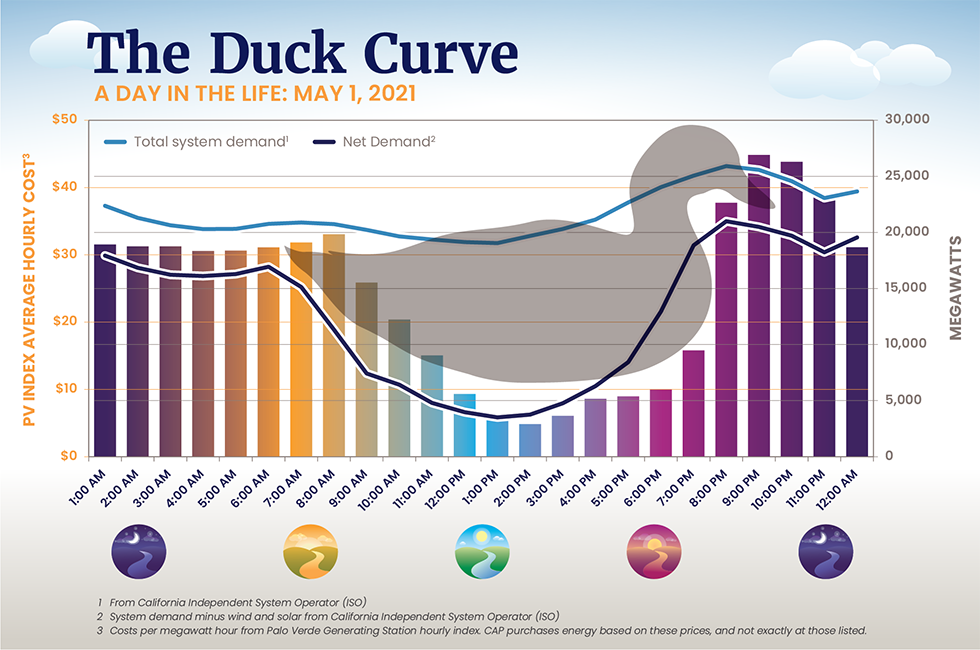
“Taming the Energy Duck”: How Renewable Energy is Affecting Our Power Grid

By: Austin Dewey

Reliable energy is a commodity that every American has grown accustomed to. Whether plugging in our toasters in the morning to make the perfect bagel sandwich, maintaining comfortable temperatures in our living spaces during the winter, or being held on a ventilator at the hospital, having a reliable energy grid is essential to our society. Additionally, as we combat the current climate crisis, America has expanded its green energy infrastructure to where renewable energy generates over 20% of our electricity. [1] While this may sound like a promising step toward a sustainable future, our aging energy grid and infrastructure are running into a higher risk of failure with every green advancement, particularly with solar energy. This dilemma has been described as the Duck Curve Problem.

The top line of this graph represents the grid’s energy demand from nonrenewable sources over 24 hours, while the bottom line shows the demand when solar renewable energy is factored in. The significant drop in midday energy demand provided by solar energy, contrasted with the sharp rise in the evening, creates the famous ‘duck’ shape seen in the graph. This steep and quick rise in energy demand puts huge strains on nonrenewable power plants which risk overgeneration to compensate for the energy use differential. This imposes higher prices on consumers, causes infrastructure damage, and threatens our national security.

To curtail this problem, the Biden Administration, under the Infrastructure Investment and Jobs Act (IIJA), has launched a joint grid modernization initiative with twenty-one states toupgrade approximately 100,000 miles of existing transmission lines. [2] This will allow for advancements in battery technology, which will help store midday solar energy and allow for a gradual release of energy when the sun goes down, which will reduce the strain on power plants. Recently, the California Energy Commission has used IIJA funding to expand 100 miles to their power grid to allow multiple sources of renewable energy input such as wind and hydroelectric, to reduce the effects of the duck curve. [3] This is an effective solution because hydroelectric and wind energy input will buffer the drastic evening energy demand.

While the IIJA is a critical step toward enhancing the reliability of the U.S. power grid, further state-level legislative action is needed to meet renewable energy goals without posing a threat to our energy grid infastructure. California’s Energy Storage Mandate serves as a key example. This innovative mandate requires the state’s three major utility companies: Pacific Gas and Electric, Southern California Edison, and San Diego Gas & Electric to procure a combined 1,325 megawatts (MW) of energy storage over ten years. [4] This initiative has proven highly successful, as all three utilities have nearly met their procurement targets. [5] By expanding energy storage capacity, this legislation ensures more efficient use of renewable energy, reducing strain on the grid and helping to stabilize electricity prices during periods of high demand. 

As we continue to expand renewable energy and modernize our grid, innovative green legislation in energy storage will be essential to overcoming the challenges of the Duck Curve and ensuring a reliable, sustainable future for America’s energy infrastructure.

____________________

[1] Renewable Energy, U.S. Dep’t of Energy, https://www.energy.gov/eere/renewable-energy (last visited Oct. 5, 2024).

[2] Biden Administration Partners with 21 States on Grid Modernization Initiative, S&P Glob. Commodity Insights (May 29, 2024), https://www.spglobal.com/commodityinsights/en/market-insights/latest-news/electric-power/052924-biden-administration-partners-with-21-states-on-grid-modernization-initiative.

[3] California Receives More Than Half a Billion Dollars in Federal Funds to Improve Power Grid, Off. of the Governor of Cal. (Aug. 6, 2024), https://www.gov.ca.gov/2024/08/06/california-receives-more-than-half-a-billion-dollars-in-federal-funds-to-improve-power-grid/.

[4] Cal. Assem. B. 2514, ch. 469, 2010 Cal. Stat.

[5] 2022 CAL. PUC LEXIS 171, 2022 CAL. PUC LEXIS 171

A Digital Dilemma: The Legal Responsibility of Tech Companies for Impacts on Mental Health

By Kaitlin Sommer

The emergence of social media has impacted our mental health in a way more complex than we may understand for hundreds of years. U.S. Surgeon General Murthy has called for warning labels on social media to remind users that this has not been proven safe.[1] Further, adolescents who spend a significant amount of time online are at risk for anxiety and depression.[2] So, what about the companies behind these platforms? What liability do they have, if any, to the effects of social media on the general public?

Currently, there is an ongoing lawsuit by more than 40 states who are suing Meta, one of the largest operators of several social media platforms.[3] The claims under this lawsuit are that Meta is responsible for harmful features such as “recommendation algorithms, social comparison features, infinite scroll, notifications and alerts, and photo filters” which all have negative links to addictive behavior and mental health conditions, like body dysmorphia.[4] This lawsuit requests remedies such as fines, penalties, and orders to stop using some problematic features.[5] 

Additionally, there is litigation in one California court assessing the liability social media companies have about the potential effects on mental health.[6] The plaintiffs argue that failure-to-warn claims should be applied without a physical product at issue, and this would just be the law evolving to keep up with the times.[7] Opposing counsel argues this type of product liability is not applicable, since it tailors the experience to each user.[8] Similar lawsuits have been filed by parents, school districts, and attorneys general (AGs), claiming similar injuries.[9]

What About the Kids: 

This question is being challenged specifically on behalf of children, and the impact it has on their development. New York, California, and Utah have passed similar laws allowing parents to have greater control over their children’s algorithms and social media uses.[10] California’s law defines an “addictive feed as a website or app in which multiple pieces of media generated or shared by users are … selected or prioritized for display to a user based … on information provided by the user.”[11] 

TikTok’s defense to claims that it is misleading and threatening to adolescents is that they have already provided the safeguards necessary.[12] These protections include removing suspected underage users, “default screen time limits, family pairing, and privacy by default for minors under sixteen.”[13] The response from the New Jersey AG is that the safety features are misleading for parents, and the time restraints can be easily bypassed through passwords or eliminating the limit.[14] 

The ongoing litigation for liability in the social media space will set up future standards for how seriously we take threats to our mental health. The resolution of these legal challenges could set important precedents for accountability in the tech industry while balancing a First Amendment right to free speech on these platforms. 

________________________________________________________________________________

[1] Cristiano Lima-Strong and Aaron Gregg, Surgeon General Calls For Social Media Warning Labels, The Washington Post (Updated June 17, 2024), https://www.washingtonpost.com/technology/2024/06/17/surgeon-general-social-media-warning-labels/

[2] Id.

[3] David Goguen, Lawsuits for Social Media Addiction and Mental Harm, Nolo.com (Updated September 18, 2024), https://www.nolo.com/legal-encyclopedia/lawsuits-for-social-media-addiction-and-mental-harm.html

[4] Id.

[5] Id.

[6] Rachel Scharf, Social Media Apps Don’t Need User Warnings, MDL Judge Told, Law360 (October 10, 2024), https://www.law360.com/cybersecurity-privacy/articles/1889256/social-media-apps-don-t-need-user-warnings-mdl-judge-told

[7] Id.

[8]Id.

[9] Id.

[10] Sophie Austin, California Governor Signs Law to Protect Children From Social Media Addiction, AP News (September 21, 2024), https://apnews.com/article/california-social-media-addiction-children-law-bc649326701f892a16be1159bc008d71

[11] Id.

[12] George Woolston, AGs Slam TikTok With Youth Addiction, Fraud Claims, Law360 (October 8, 2024), https://www.law360.com/media/articles/1887891/ags-slam-tiktok-with-youth-addiction-fraud-claims.

[13] Id.

[14] Id.

The Dark Side of SEO: How Anti-Abortion Groups Use Search Engine Optimization to Mislead and Manipulate

Created with Canva AI

By: Elle Borgdorff

Looking for a restaurant? What do you do? Most people would say – “Google it.” Search engines are a part of everyday life. We look up where to eat, what store we should shop at, what events are happening near us, and more. People seeking abortions or access to information regarding reproductive healthcare are no different. They frequent search engines to find access to critical reproductive healthcare. But what happens when those search engines are manipulated by those that have an ulterior motive?

Search engine optimization (SEO) is “the process of improving your website to increase its visibility in Google, Microsoft Bing, and other search engines.”[1] Because “organic search[es]” are responsible for 53% of all website traffic, SEO is a critical part of modern marketing strategies.[2] Notably, the global SEO industry is estimated to reach $122.11 billion by 2028.[3]

Companies or websites can use SEO to their advantage by using “the right keywords and phrases to improve their appearance in search results.”[4] In this way, SEO can be used to attract specific audiences to a webpage, including vulnerable individuals seeking access to reproductive healthcare information. Anti-abortion pregnancy centers in the United Sates have “spent an estimated $10.2 million on Google Search ads” and “those ads were clicked on an estimated 13 million times” in a two-year period.[5]

Human Coalition is credited with starting the trend for pro-life organizations use of SEO to their advantage.[6] Human Coalition is a “pro-life nonprofit organization committed to an audacious mission: to transform our culture of death into a culture of life – to end abortion in America.”[7] Human Coalition has “applied corporate digital marketing techniques” like SEO, to “manipulate pregnant peoples’ online search results, driving those researching abortion away from comprehensive pregnancy care or abortion clinics”.[8] 

Users who search ‘pregnancy test’, ‘pregnancy’ or ‘abortion’ are frequently redirected to websites for Crisis Pregnancy Centers (CPC’s).[9] CPC’s are “nonprofit organizations that present themselves as healthcare clinics while providing counseling explicitly intended to discourage and limit access to abortion.”[10] These centers, “are rarely licensed to provide health care and do not offer accurate information or refer patients for abortion care, emergency contraception, or comprehensive prenatal care, and they do not make referrals to abortion providers.”[11] 

Heartbeat International is a “pro-life pregnancy resource center” with over 3,600 “affiliated pregnancy help locations.”[12] Heartbeat International has also manipulated SEO to their advantage.[13] They have gone as far as to boast that an individual “who makes a Google search such as ‘pregnant and scared’ finds a local Heartbeat International affiliate.”[14]

Human Coalition and Heartbeat International are not the exception. Manipulation of SEO to support a pro-life agenda is so commonplace that entire companies exist to support CPCs in this messaging. Choose Life Marketing is a marketing company, seeking to help clients (pro-life groups) use SEO to their advantage.[15] Their website states that “an SEO strategy can help more people who want to learn about or support the pro-life mission find your organization. Our team will do the necessary research to learn what keywords your target audience is searching for, and then we will optimize your site to help you reach that audience.”[16]

SEO is deliberately manipulated to redirect pregnant people to CPC’s and mislead them into misinformation surrounding abortion and to dissuade individuals from having abortions.[17] The CPC’s “often present themselves as medical facilities and mirror abortion clinics’ logos, using names like Your Choice and Women’s Health Clinic.”[18] CPC’s have also used “sophisticated digital tactics like ‘geo-fencing’ to intercept people in the waiting rooms of physician’s offices and vulnerable populations like high school students.”[19]

These tactics are deceptive and can have serious implications. For years, those in favor of reproductive rights have urged Google to prevent CPCs from running “misleading abortion-related ads” on their platform. However, because CPCs are not “selling anything, they do not fall under the purview of the Federal Trade Commission Act, which prohibits unfair or deceptive advertising.”[20] A group of Democrats in Congress urged Google to protect users from “misleading abortion-related search results” in June 2022, weeks before the groundbreaking decision in Dobbs v. Jackson Women’s Health Organization, overturning Roe v. Wade and erasing Constitutional protection for abortions.[21]

Two years later, not much has changed. In 2024, women are still googling “abortion near me” and being directed to CPC’s.[22] Sudden abortion bans and restrictions in the aftermath of Dobbs only increases the dangers these centers cause. These centers “aim to delay medical procedures until it is too late to legally terminate a pregnancy, which these centers never present as an option.”[23] As State Senator from Pennsylvania Katie Muth has stated – Action is needed to ensure “consumers are protected from sham centers that spend millions of dollars on deceptive marketing to advertise themselves as health care centers, when in fact they don’t actually provide such service… These deceptive practices can lead to human harm and even the death of an expecting mother because of a delay in care caused by these centers wasting precious time with sham guidance.”[24]

——————————————————————————————————————–

[1] What Is SEO – Search Engine Optimization, Search Engine Land, https://searchengineland.com/guide/what-is-seo (last visited Sep. 22, 2024).

[2]Organic Search Responsible For 53% of all site traffic, paid 15% [Study], Search Engine Land https://searchengineland.com/organic-search-responsible-for-53-of-all-site-traffic-paid-15-study-322298 (last visited Sep. 22, 2024).

[3] What Is SEO, supra note 1. 

[4] Jack Dobkin, In The Grand Scheme: Six Sinister Tactics Employed by Anti-Abortion Centers, Equity Forward (last visited Sep. 22, 2024) https://equityfwd.org/research/grand-scheme-six-sinister-tactics-employed-anti-abortion-centers. 

[5] Laurel Wamsley, Google Shows You Ads for Anti-Abortion Centers When Yoy Search For Clinics Near You, Npr (Jun 22, 2023) https://www.npr.org/2023/06/22/1182865322/google-abortion-clinic-search-results-anti-abortion.

[6] Dobkin, supra note 1.

[7] Human Coalition, https://www.humancoalition.org/ (last visited Sep. 22, 2024).

[8] Dobkin, supra note 1.

[9]What Reproductive Rights Advocates Need to Know About Anti-Abortion Crisis Pregnancy Centers, Planned Parenthood Advocacy Fund of Massachusetts, Inc. https://www.plannedparenthoodaction.org/planned-parenthood-advocacy-fund-massachusetts-inc/issues/what-reproductive-rights-advocates-need-to-know-about-anti-abort#:~:text=They%20also%20utilize%20search%20engine,people%20away%20from%20real%20reproductive (last visited Sep. 22, 2024).

[10]Melissa N Montoya, Colleen Judge-Golden, Jonas J. Swartz, The Problems With Crisis Pregnancy Centers: Reviewing the Literature and Identifying New Directions for Future Research, (May 24, 2022) https://doi.org/10.2147/IJWH.S288861

[11] Planned Parenthood Advocacy Fund of Massachusetts, Inc., supra note 9. 

[12] About Us,Heartbeat International, https://www.heartbeatinternational.org/about-us (last visited Sep. 22, 2024).

[13] 2014 Annual Report, Heartbeat International, https://www.heartbeatinternational.org/images/PDF/2014AnnualReport.pdf (last visited Sep. 22, 2024). 

[14] Id.

[15] Pro-Life Search Engine Optimization (SEO), Choose Life Marketing, https://www.chooselifemarketing.com/services/digital-marketing/seo/ (last visited Sep. 22, 2024). 

[16] Id.

[17] Abigail Abrams and Vera Bergengruen, Anti-Abortion Pregnancy Centers Are Collecting Troves of Data That Could Be Weaponized Against Women, (Jun. 22, 2022 12:02 PM EDT) https://time.com/6189528/anti-abortion-pregnancy-centers-collect-data-investigation

[18] Id.

[19] Rep. Bridget Kosierowski and Rep. Melissa Shusterman, A Post-Roe PA: deceptive Practices of Anti-Abortion Centers, PA House Democratic Policy Comm. and PA Senate Democrats Policy Comm. (Sep. 6, 2022 1:00 pm) https://www.pahouse.com/files/Documents/Testimony/2022-09-06_034351__Sept6HearingDocs.pdf

[20] Emma Cott, Nilo Tabrizy, Aliza Aufrichtig, Rebecca Liberman and Nailah Morgan, They Serached Online for Abortion Clinics. They Found Anti-Abortion Centers., The New York Times (Jun. 23, 2022) https://www.nytimes.com/interactive/2022/us/texas-abortion-human-coalition.html

[21] Id.

[22] Ashley Adams, Exposed: This PA Woman’s Story Reveals How Crisis Pregnancy Centers Deceive Women, The Keystone (Feb. 28, 2024) https://keystonenewsroom.com/2024/02/28/exposed-this-pa-womans-story-reveals-how-crisis-pregnancy-centers-deceive-women/

[23] Id.

[24] Id.

How a Gap in Regulations Keeps Human Composting Illusive to New Yorkers

By Tristan Turner

Traditional methods of human disposition, namely burial and cremation, have been a tradition of many cultures for thousands of years.[1] However, the carbon footprint and environmental impact of these traditions had not been considered until relatively recently in the 1990s by the Green Burial Council. [2] They discovered that one cremation uses up to 500 gallons of fuel, and releases up to 250 lbs of CO2 per person. [3] That is the equivalent of driving a car for 400 miles. [4] More than 2 Million people are cremated each year in the United States, and as the costs of traditional burial continue to rise, cremation rates will continue to trend upwards. [5]    

Scientists and environmentalists have been working together to find ways to respectfully dispose of human remains while reducing the 360,000 metric tons of carbon dioxide produced each year. [6] One method, which became legal in New York in 2022, is human composting. [7] Human composting, also known as terramation, is a process that breaks down the remains into nutrient-dense soil by speeding up the natural decomposition processes of bacteria and fungi.[8] The body is placed into a chamber with wood chips and straw, and heated for 5-7 weeks.[9] The family can then keep the soil for personal use in a garden or donate it to their local community. [10]

Unfortunately for New Yorkers, as of today September 13th, 2024, there has yet to be an application to construct a human composting facility.[11] Cemetery boards cite a lack of consumer interest because they have yet to apply, but this is a circular argument.[12] Due to the lack of facilities and subsequent lack of advertising for the service, consumers do not know that human composting is an option in New York. Additionally, many consumers who are interested in the procedure know that there is a lack of facilities in New York that can provide it, so they do not ask for it. 

A lack of State regulations regarding the requirements of constructed facilities also stands as a roadblock, preventing facilities from opening in New York. The funeral industry is heavily regulated by State and Federal Law. Funeral homes and crematories are statutorily required to have certain rooms, such as a viewing room or chapel, to operate legally.[13] These regulations also require that the rooms be of a certain size and that some rooms cannot be connected.[14] No such regulations exist in the assembly bill that legalized human composting facilities.[15] Cemetery boards are not willing to spend millions of dollars on a facility when there is a precedent of building requirements with this level of specificity. This leaves them with the potential to construct a facility that is not up to code, leaving them unable to operate legally without incurring further renovation costs to bring the facility into compliance. 

Overall, as global CO2 levels continue to rise, it is important to provide individuals with an option to lessen their carbon footprint, even after death. Currently, the lack of regulations for human composting facilities leaves New Yorkers unable to do their part to minimize their environmental impact.

______________________________________________________________________________________________________

[1]https://csnh.com/blog/the-history-of-cremation/#:~:text=The%20first%20evidence%20of%20cremation,Neolithic%20period%20(9500%20B.C).

[2]https://www.orderofthegooddeath.com/article/whose-green-burial-is-it-anyway/#:~:text=Part%20of%20this%20unpacking%20process,stuffy%2C%20and%20needlessly%20expensive).

[3]https://www.greenburialcouncil.org/disposition-statistics-media.html#:~:text=Vault%20burial%20emits%20approximately%20250,%2C%20watering%2C%20etc.).

[4]https://www.epa.gov/greenvehicles/greenhouse-gas-emissions-typical-passenger-vehicle

[5]https://www.pulvisurns.com/blogs/news/cremations-are-on-the-rise-which-countries-are-leaders#:~:text=In%202020%2C%20the%20US%20death,2%20million%20people%20chose%20cremation.

[6]https://www.nationalgeographic.com/science/article/is-cremation-environmentally-friendly-heres-the-science

[7]https://www.nysenate.gov/legislation/bills/2021/A382

[8] https://www.webmd.com/balance/what-is-human-composting

[9]https://recompose.life/faqs/how-does-human-composting-work/

[10] Id.

[11]https://www.timesunion.com/state/article/human-composting-now-legal-remains-elusive-new-18664998.php

[12] Id.

[13]https://regs.health.ny.gov/content/section-775-funeral-establishments

[14]Id.

[15] https://www.nysenate.gov/legislation/bills/2021/A382

Fighting the Prescription Drug Cost Crisis: How the New Medicaid Drug Price Negotiation Guidelines Measure Up to European Strategies for Controlling Costs

By: Claire Reynolds-Peterson

The Inflation Reduction Act (IRA) passed on August 16th, 2022, introduced a novel and historic power to the Centers for Medicare and Medicaid Services (CMS): the ability to negotiate prices of covered prescription medications directly with pharmaceutical companies.[1] This landmark legislation aims to address one of the underlying causes of the healthcare cost crisis that has raged in the United States for many years, the exorbitant cost of name-brand prescription medications. The first ten drugs selected for price negotiation were announced on August 29th, 2023, targeting therapeutically unique drugs and biologicals that have been licensed for at least 7 or 11 years respectively.[2] The selected drugs represent the highest contributors to covered prescription drug costs under Medicare Part D.[3] All of the affected manufacturers have agreed to participate in negotiations, though many of them are challenging the constitutionality of the IRA in ongoing litigation.[4]

The pharmaceutical giants challenging the legislation argue government interference in drug pricing will stifle innovation and curtail their ability to invest in novel drug development.[5] However, federal investigation of drug pricing revealed that revenue targets have often been tied to increasing executive pay, with companies spending more on stock buy backs than research and development.[6] Furthermore, pharmaceutical companies rarely perform basic scientific research, instead relying on taxpayer-funded academic research to identify drugs likely to produce commercial success based on extant preliminary data.[7] This argument is also undermined by the staggering discrepancy between prescription drugs costs in the United States versus other wealthy nations.

The United States spent $11,702 per capita on healthcare in 2020, a stunning 18.82% of the national gross domestic product (GDP).[8] Germany, France, and the United Kingdom, countries that negotiate pharmaceutical drug prices, put 12.82, 12.21, and 11.98 percent of GDP respectively to healthcare spending in 2020.[9] Approximately one in seven dollars of US healthcare spending goes to prescription drugs alone, leading to the highest per capita spending on drugs of any country— and US drug prices continue to rise rapidly.[10] Between 2016 and 2020, branded prescription drug prices rose 36%, four times the rate of inflation.[11] Germany, France, and the UK all impose control over drug price increases by prohibiting cost increases without additional regulatory review and government approval, in addition to negotiating starting prices immediately upon drug licensing.[12]

As a case study of the effects of price negotiation and capping, the cost of the multiple sclerosis drug Gilenya® was compared between these countries.[13] In the US, the drug costed approximately $84,461 per person per year (in 2022 adjusted dollars), which rose to $116,193 by 2022.[14] In Germany, France, and the UK, the drug costed $43,450, $40,899, and $39,120 US dollars per person per year, with statutory measures preventing price increases over time.[15] This result is on-par with the general trend of US brand-name drugs costing 256% of the average price other countries pay for the same medications.[16] If Medicare had been able to pay the French negotiated drug prices for the six individual drugs that incurred the greatest expenditures in 2017, the government would have saved an estimated $5.1 billion dollars.[17]

As it stands, the IRA negotiation procedures are unlikely to produce results comparable to these other countries. While the European countries set prices upon licensing, the IRA only begins negotiation after a protected period of seven or eleven years during which the pharmaceutical company may set their own price.[18] The IRA then sets a price ceiling based on average non-government manufacturer price from 2021 adjusted in accordance with the increase in the consumer price index, or the first full year after market entry if licensed after 2021.[19] This ceiling price is then reduced by a flat percentage based on how long the drug has been on the market.[20]

The IRA does not reference drug prices in other countries to aid in establishing a fair price, instead relying on domestic free market competition to control the starting price.[21] In contrast, Germany, France, and the UK do not rely on free market pricing. Instead, they look to measures including pricing in other countries (sometimes specifically excluding the US), pricing of alternative treatments, of other treatments in the same therapeutic class, and the actual cost-effectiveness of the treatment in terms of quality-adjusted life-years.[22] Given the common use of anticompetitive strategies to suppress competition and the general failure of market competition to adequately control prices, this appears to be a losing strategy for addressing unreasonable US drug costs.[23]

With lawsuits from six pharmaceutical companies and two industry groups ongoing, the longevity of the IRA provisions for Medicare drug price negotiation remains to be determined.[24] The pharmaceutical companies argue the potential reduction in their profits will stifle innovation and lead to the development and licensing of fewer new drugs in the future.[25] On the other hand, Americans across the political spectrum approve of the new negotiation power and view industry challenges to the legislation very unfavorably.[26] Based on the Congressional investigation into factors underlying drug pricing, including corporate expenditures, the threatened decrease in pharmaceutical innovation could be offset by directing a higher proportion of revenue towards research and development in the future.[27] If reining in astronomical drug prices in the US truly does have the catastrophic drawbacks threatened by the pharmaceutical industry, it may be time to question why the burden of paying such disproportionate costs in support of pharmaceutical innovation falls uniquely on American consumers.

———————-

Citations:

  1. Inflation Reduction Act of 2022, Pub. L. No. 117–169, 136 Stat. 1818 (codified as amendments to one hundred thirty-eight different U.S.C sections); Price Negotiation Program to Lower Prices for Certain High-Priced Single Source Drugs, 42 U.S.C.A. § 1320f (Westlaw through Pub. L. No. 118-13).
  2. Medicare Drug Price Negotiation Program: Selected Drugs for Initial Price Applicability Year 2026, CTRS. FOR MEDICARE & MEDICAID SERVS., (Aug. 2023), https://www.cms.gov/files/document/fact-sheet-medicare-selected-drug-negotiation-list-ipay-2026.pdf.
  3. Id.
  4. Sydney Lupkin, All in: Drugmakers say yes, they’ll negotiate with Medicare on price, so reluctantly, NPR (Oct. 4, 2023, 5:00 AM), https://www.npr.org/sections/health-shots/2023/10/04/1203417818/medicare-drug-price-negotiations-begin.
  5. Id.
  6. STAFF OF H.R. COMM. ON OVERSIGHT AND REFORM, 117TH CONG., REP. ON DRUG PRICING INVESTIGATION, at 40–42, 164–67 (Dec. 10, 2021). https://oversightdemocrats.house.gov/sites/democrats.oversight.house.gov/files/DRUG%20PRICING%20REPORT%20WITH%20APPENDIX%20v3.pdf
  7. Id. at 175.
  8. Global Health Expenditure Database, WORLD HEALTH ORGANIZATION (Oct. 10, 2023), https://apps.who.int/nha/database/country_profile/Index/en (select United States of America from drop down menu).
  9. Global Health Expenditure Database, WORLD HEALTH ORGANIZATION (Oct. 10, 2023), https://apps.who.int/nha/database/country_profile/Index/en (select Germany, France, and United Kingdom respectively from drop down menu); Leah Z. Rand & Aaron S. Kesselheim, Getting the Price Right: Lessons for Medicare Price Negotiation from Peer Countries, 40 PHARMACOECONOMICS 1131, 1131 (2022).
  10. Rand, supra note 9, at 1131.
  11. H.R. COMM. ON OVERSIGHT AND REFORM, supra note 6, at iii.
  12. Rand, supra note 9, at 1134, 1135, 1138.
  13. Id. at 1136.
  14. Id.
  15. Id.
  16. ANDREW W. MULCAHY ET. AL., INTERNATIONAL PRESCRIPTION DRUG PRICE COMPARISONS XV (RAND Corporation 2021)(eBook)
  17. Rand, supra note 9, at 1135.
  18. Id. at 1139; CTRS. FOR MEDICARE & MEDICAID SERVS., supra note 2.
  19. 42 U.S.C.A § 1320f-3(c) (Westlaw through Pub. L. No. 118-13).
  20. Id.
  21. Rand, supra note 9, at 1139.
  22. Rand, supra note 9, at 1132, 1134–35, 1137–38.
  23. H.R. COMM. ON OVERSIGHT AND REFORM, supra note 6, at i–ii, 80, 94–95, 173.
  24. Joshua Cohen, Lawsuits to Block Medicare Drug Price Negotiations are Unpopular Among Voters, FORBES (Oct. 1, 2023), https://www.forbes.com/sites/joshuacohen/2023/10/01/lawsuits-to-block-medicare-drug-price-negotiations-are-very-unpopular-among-american-voters/?sh=6f589a932d28.
  25. Id.
  26. Id.
  27. See H.R. COMM. ON OVERSIGHT AND REFORM, supra note 6.

Battle of the Circuits: The Constitutionality of Social Media Laws in Texas and Florida

By: Rebekah Gil

For years, social media platforms have been the main source of news and political information for users across the globe. However, those platforms have also been questioned on the reliability of the content published and promoted throughout their apps.

In August 2021, Texas passed House Bill 20 which prohibits large social media platforms from moderating content based on a user’s viewpoint and geographic location.[1] The bill additionally states that it applies to platforms regardless of whether the viewpoint is expressed on a social media platform or through another medium.[2] Some of those large social media platforms are represented by trade associations whose mission is to make the internet safe.[3] NetChoice is an example of one association, created in 2001, that represents some of the largest social media platforms like Meta, TikTok, and X.[4] Their specific mission states they “work to make the Internet safe for free enterprise and free expression”.[5]

Right before the H.B. 20 bill passed, NetChoice filed a suit against Texas, arguing the bill violated social media platforms’ First Amendment right to free speech.[6] The main argument was focused on the idea that social media platforms are similar to newspapers and similarly have a constitutional right to protected speech in the form of editorial discretion.[7]

On September 16, 2022, after back and forth between the courts, the Fifth Circuit upheld Texas’s law entirely.[8] In agreement with Texas’s main argument, the Fifth Circuit labeled social media platforms as “common carriers”.[9] Meaning, they facilitate the transmission of speech, like phone companies and postal services.[10] The court concluded that the platform’s censorship is not speech under the First Amendment, and therefore the House Bill remains constitutional.[11] This ruling contradicts an Eleventh Circuit decision decided just five months prior.

Similar to Texas, Florida passed SB 7072 which also regulates social media platforms, and limits their ability to censor and remove content based on political viewpoints.[12] However, unlike the Fifth Circuit, the Eleventh Circuit struck down the social media law in a similar case in which NetChoice was also a party.[13] The court disagreed with the notion of social media platforms acting as “common carriers”.[14] It instead declared that “[p]latforms are private enterprises, not government … entities”, siding with NetChoice that the law violates companies’ free speech rights.[15]

Other tech companies have entered the discussion saying the social media laws, should they remain enacted, will stop tech companies from controlling what content gets published, some of which could be potentially harmful.[16] While the states argue that the law will make sure users have equal access to the platforms.[17]

With both circuits at odds, the Supreme Court granted certiorari of both cases and said on September 29th that it would decide the constitutionality of the social media laws in both Texas and Florida.[18]

—-

Citations:

  1. H.R. 20, 87th Leg., 2 Sess. (Tex. )
  2. Id.
  3. NetChoice, https://netchoice.org/about/ (last visited Oct. 13, 2023)
  4. Id.
  5. Id.
  6. Nithin Venkatraman, NetChoice, L.L.C. v. Paxton: 5th Circuit Sets Up Supreme Court Battle over Content Moderation Authority of Social Media Giants, Harvard Journal of Law and Technology (Oct. 21, 2022), https://jolt.law.harvard.edu/digest/netchoice-l-l-c-v-paxton-5th-circuit-sets-up-supreme-court-battle-over-content-moderation-authority-of-social-media-giants

7. Rebecca Kern, 5th Circuit Upholds Texas Law Forbidding Social Media ‘Censorship’ — Again, Politico, https://www.politico.com/news/2022/09/16/5th-circuit-upholds-texas-law-forbidding-social-media-censorship-again-00057316 (last updated Sept. 16, 2022).
8. Amicus Brief Moody v. NetChoice, Knight First Amendment Institute at Columbia University, https://knightcolumbia.org/cases/moody-v-netchoice (last visited Oct. 13, 2023)
9. Mark Joseph Stern, The 5th Circuit’s Reinstatement of Texas’ Internet Censorship Law Could Break Social Media, Slate, https://slate.com/technology/2022/05/texas-internet-censorship-social-media-first-amendment-fifth-circuit.html ( May 12, 2022)
10. Id.
11. Netchoice, L.L.C. v. Paxton, 49 F.4th 439, 444
12. Adi Robertson, Florida’s Social Media Moderation Ban Is Probably Unconstitutional, Says Court, The Verge (May 23, 2022, 4:23 PM), https://www.theverge.com/2022/5/23/23138172/eleventh-circuit-blocks-florida-content-moderation-ban
13. Id.
14. Id.
15. Id.
16. Ashley Capoot, Supreme Court to Hear Texas and Florida Social Media Cases over Right to Moderate Content, CNBC, https://www.cnbc.com/2023/09/29/supreme-court-to-hear-texas-and-florida-social-media-cases.html (last updated Sept. 29, 2023)
17. Id.

18. Amy Howe, Justices Take Major Florida and Texas Social Media Cases, SCOTUS Blog (Sept. 29, 2023, 9:48 AM), https://www.scotusblog.com/2023/09/justices-take-major-florida-and-texas-social-media-cases/

Creating Optionality for Esports Organizations: Drafting Sponsorship Deals to Bar a Frustration of Purpose Defense

By: Nathan McKay

With a recent fall in venture capital funding the Electronic Sports industry (Esports) has fallen on tough times.[1] Esports is a catchall term referring to any competitive video game league. Esports organizations will often field multiple teams each specializing in a particular game, each with its own associated league. Esports has always been a dynamic industry and while there are longstanding staples such as League of Legends and Call of Duty, recent years have seen entire leagues rise and fall and occasionally rise again.[2] This means that larger organizations find themselves in a precarious situation, wanting to field teams in new leagues while minimizing risk in the event that any particular league or team doesn’t gain traction. 

To understand the risk esports organizations face one must understand what makes esports different from the traditional sports industry. Importantly, one must understand how esports teams generate revenue. Whereas traditional sports organizations generate revenue from a variety of sources, esports teams are limited to their post-publisher cut share of league revenue (usually spent entirely on player salaries, another topic of discussion), and any revenue generated from sponsorships and merchandising.[3] Unlike traditional sports organizations, generally, esports organizations don’t own arenas, they don’t sell their own tickets to games, and they don’t sell concessions and other high-margin items to fans. In fact, only a small portion of esports games are actually played in front of a large arena audience.[4] Most games are live-streamed via Twitch and YouTube in smaller studios with occasional attendance room for a small number of dedicated fans and only the larger end-of-season tournaments being held in large arenas.[5] As a result, sponsorships and merchandising are the primary sources of revenue for esports teams, unlike traditional sports teams who usually only rely on these for about 10% of their revenue.[6]

For most of the large games, including League of Legends, the game publisher retains league rights and with it the ticket sales and a large cut of streaming revenue. Riot Games, the publisher of League of Legends, a game with one of the largest esports followings, owns and operates leagues in each major region around the world, with teams paying, currently, around $20 million dollars for a slot in North America. Riot uses live venue revenue to cover costs, usually running the league at a loss as an advertisement for their game and service for the fans.[7]Organizations that field teams within the league are afforded a portion of league revenue, dependent on the league and its associated publisher, but this often isn’t enough to offset costs alone. 

Due to limited revenue options, esports organizations depend on their sponsors more so than other comparable sports organizations as it is one of the few large revenue sources available. Therefore, any loss in sponsorship revenue presents an immediate problem. Sponsors have begun treading carefully around the esports industry [8] and as organizations sell or dissolve specific teams in an effort to adapt to current challenges, sponsors may attempt to cease payment for promotional deals citing a loss in viewership and value to the bargain. Sponsors can potentially defend this breach with the doctrine of frustration of purpose. The strength of this defense will depend on the specificity of deliverables and other provisions within each agreement, particularly any special recognition of the viewership value of specific teams within an organization. Absent these kinds of unique provisions it is highly unlikely that the sale of one or even two high viewership teams under an organization would result in a defensible breach under the frustration of purpose doctrine. This is because it is unlikely that advertisement with a single specific team would be found to be the basis of the contract in a deal where the deliverable is stated as promotion across an organization, its teams, and its players with no additional language pointing to specific teams or players. 

Frustration of purpose, a defense to enforcement, requires a party’s principal purpose to be substantially frustrated without their fault by the occurrence of an event the non-occurrence of which was a basic assumption on which the contract was made.[9] The frustrated purpose must be so completely the basis of the contract that, as both parties understood, without it, the transaction would have made little sense. [10]The doctrine applies when a change in circumstances makes one party’s performance virtually worthless to the other.[11]

A distinction often made is that between a ticket to view an event and a prepaid taxi to an event venue purchased at a markup due to the event. If the event is canceled the ticket holder is due repayment (or is excused for breach through non-payment) because the sole purpose in purchasing the ticket was to view the event, a purpose that was frustrated by the cancelation of the event making the ticket worthless. Conversely, there is no defensible breach in the purchase of a prepaid taxicab to the venue because the rider can still receive what they bargained for, transportation to the venue, it might’ve lost significant value, however, it is not virtually worthless.[12]

Esports organizations will likely have enforceable contracts where the language supports a bargain for advertisement across an organization, without pointing to the particular team or player. Ideal wording, resistant to the frustration of purpose defense in the wake of a team or player sale, where esports organizations seek to enforce sponsorship contracts, would be very general in nature avoiding the identification of specific teams and players. An example might be “[Organization] is to promote [Sponsor] across its Teams, Content Groups, Creators, and Players…”. This kind of wording would suggest that the sponsor bargained for promotion across the organization as a whole and the sale of even the highest viewership team would not render the principle purpose of the sponsor “virtually worthless”. Similar to the taxicab, the sponsor can still receive promotion across the organization, even if such promotion has lost value. For the performance under a general provision to be rendered virtually worthless, the organization would have to dissolve a substantial number of teams and player contracts, such that there is almost no viewership for the sponsor. At this point, other problems would be of greater concern. 

Recently in esports news, Team Solo Mid (TSM), a large and very popular esports organization with teams across multiple popular games including Apex LegendsDota 2Tom Clancy’s Rainbow 6 Siege, and more, announced they would selling their slot in the League Champion Series (the League of Legends North American league) and would searching for opportunities in other regions.[13] This calls to question what might happen with their current sponsors. TSM has multiple sponsors including GEICO, Grubhub, Lenovo, Mountain Dew Game Fuel, and more. TSM’s LCS League of Legends team pulled massive viewership, especially in larger games, peaking at an all-time high of 1.7 million viewers during the 2020 League of Legends World Championship.[14] It is without a doubt that TSM’s LCS team represented a valuable component when sponsorship agreements were made. With the LCS team gone and at least a year until TSM fields another League of Legends team in a different region one can be almost certain that sponsors are bringing TSM to the table to have a discussion about deliverables. Retaining sponsor capital will be paramount for TSM, especially in the wake of their former title sponsor FTX going under in the recent crypto crash.[15]

It remains to be seen what will happen. Sponsors will likely raise frustration of purpose as a defense to non-payment, however, TSM might make offers to proportionally reduce payments in light of the recent change. Everything will depend on how provisions surrounding specific deliverables have been worded. If sponsorship contract deliverables fail to mention any specific team or player then it is likely that TSM will have a solid foundation upon which they can stand their ground and demand full payment under threat of further litigation. However, these deals do not exist in a vacuum, and one must consider if enforcement of the current deal over a mutual renegotiation is worth any potential loss of future goodwill among sponsors. A consideration especially prudent during a time when the Esports industry is undergoing massive change and uncertainty.

——

Citations:

1. Cecilia D’Anastasio, The hype around esports is fading as investors and sponsors dry up, LOS ANGELES TIMES (Dec. 8, 2022, 11:31 AM PT), https://www.latimes.com/business/story/2022-12-
08/esports-hype-fading-investors-sponsors-dry-up.


2. Michael Crossman, Top 5 companies that failed in esports, CLAIM YOUR FAME (Sept. 22, 2020) https://claimyourfame.gg/top-5-companies-that-failed-in-esports/.


3. Tim Maloney, How Do Esports Teams Make Money? ROUNDHILL INVESTMENTS (Jan. 31, 2022), https://blog.roundhillinvestments.com/how-do-esports-teams-make-money.


4. David Bloom, Esports Stadiums Are Popping Up Everywhere, FORBES (May 31, 2019, 10:44 AM EDT), https://www.forbes.com/sites/dbloom/2019/05/31/esports-stadiums-are-popping-up-everywhere/?sh=5c011ece2521 (the industry is working to catch up, building its own arenas to lower long term venue costs and increase fan bases).


5. RIOT GAMES, https://lolesports.com/article/2023-lcs-summer-split-primer–ticketing-
information/blt91bc05103f15f4d4 (last visited Oct. 13, 2023).


6. Michael Beach, NFL Franchise Values Soar Driven by Ever Expanding Media Rights, CROSS SCREEN MEDIA (Sept. 8, 2022), https://crossscreen.media/state-of-the-screens/nfl-franchise-values-soar-driven-by-ever-expanding-media-rights/.


7. Ormi Wallach, How Do Esports Companies Compare With Sports Teams?, VISUAL CAPITALIST (Jan. 29, 2021), https://esporthow.com/how-does-the-lcs-make-money/.


8. Billy Studholme, Sponsors are wising up to deals with esports teams and adjusting spending accordingly, DIGIDAY (Apr. 5, 2023), https://digiday.com/marketing/sponsors-are-wising-up-to-deals-with-esports-teams-and-adjusting-spending-accordingly/.


9. Krell v. Henry, [1903] 2 KB 740 (Eng.)


10. Shmaltz Brewing Co., LLC v. Dog Cart Mgmt. LLC, 163 N.Y.S.3d 659, 663 (2022)


11. Id.


12. Krell, [1903] 2 KB 740 (Eng.)


13. Field Level Media, TSM Sell LCS franchise to Shopify Rebellion for reported $10M, REUTERS (Sept. 22, 2023 11:28 AM), https://www.reuters.com/article/esports-lol-shopify-rebellion-tsm/tsm-sell-lcs-franchise-to-shopify-rebellion-for-reported-10m-idUSFLM2qZ0Mc.


14. ESPORTS CHARTS, https://escharts.com/teams/lol/tsm.


15. Rohan, What does the FTX collapse mean for TSM and the esports industry, (Nov. 10, 2022),https://esports.gg/opinion/esports/ftx-collapse-mean-for-tsm-and-gaming/.